
Oman’s UAE finale is about avoiding another World Cup qualifying round
Oman face UAE level with Namibia on 33 points. Fourth place buys a shorter route to the World Cup Qualifier, with an eight-team play-off awaiting the other side.
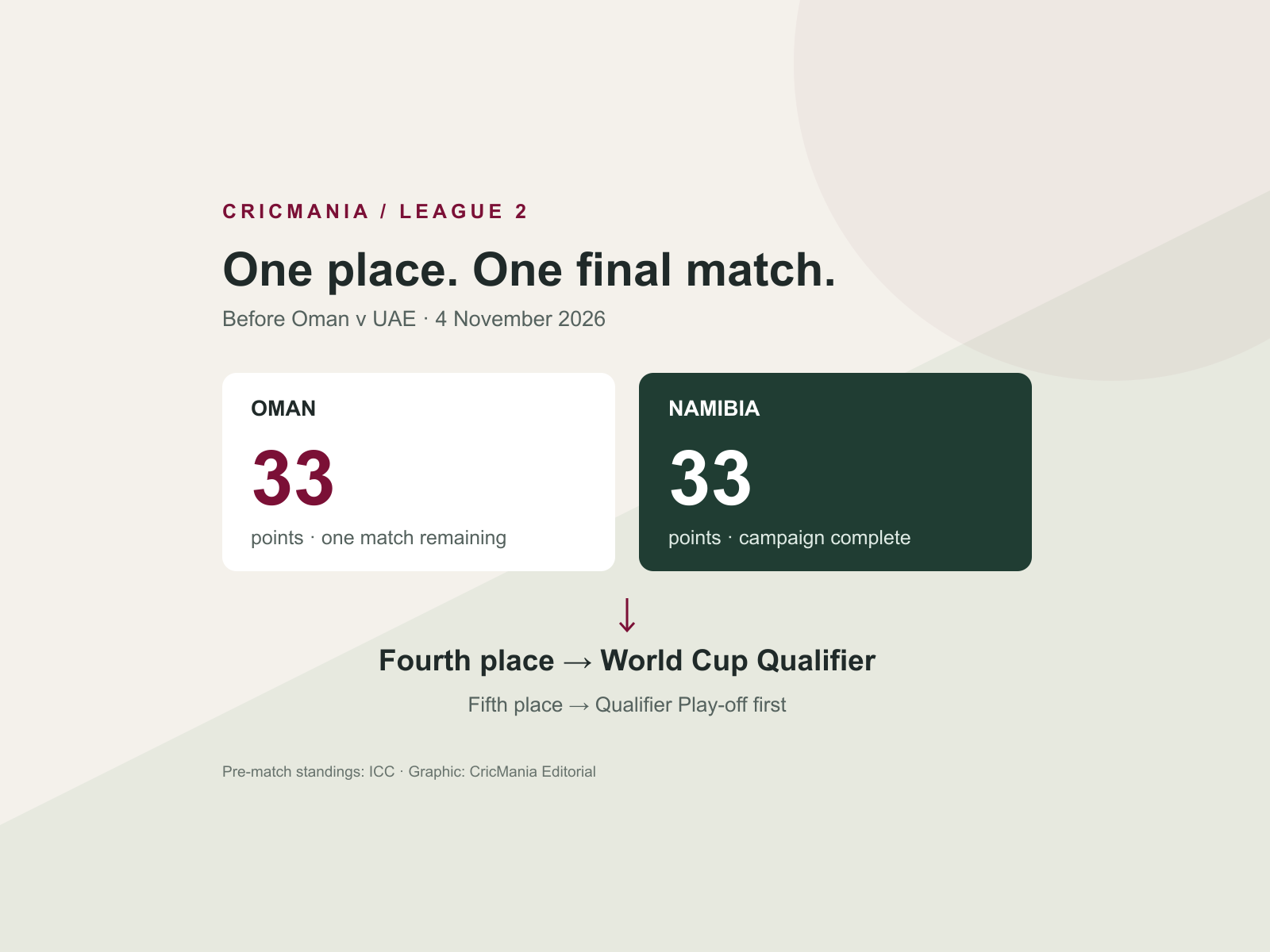
Oman face UAE on 4 November with Namibia waiting on the result: both have 33 points, but only Oman have a League 2 match left. The ICC’s final-day assessment makes the distinction clear. Oman can retain fourth even in defeat, provided the loss is not heavy enough to surrender their net run rate advantage.
The ICC’s rough danger marks are a defeat by more than 130 runs or a UAE chase completed in around 23 overs or fewer. Those are indicative scenarios, not a universal target applicable to every innings.
The prize is one fewer elimination stage
The League 2 playing conditions separate the two routes. Fourth place sends a team directly to the World Cup Qualifier. Fifth sends it to the Qualifier Play-off, alongside the other three bottom-half League 2 finishers and four Challenge League sides. Only four of that eight-team field advance to the Qualifier.
That means four of eight teams at the extra event are eliminated: half its field. It does not mean any particular team has a 50 per cent chance of surviving. Strength, conditions and performance will determine that. What fourth place guarantees is exemption from a competition that removes four contenders before the final qualifying event even begins.
The same document orders tied teams by wins before net run rate. NRR measures aggregate scoring rate against aggregate concession rate; an all-out innings uses the full allotted overs. A rounded table entry therefore cannot supply every input for a precise final-day threshold. Fans should treat the official scenario as guidance and the final adjudicated standings as decisive.
How Oman’s cushion became a final-day problem
The warning arrived on 19 October against Nepal in Al-Amerat. Oman lost by ten runs after reaching a position from which the chase remained achievable. At that point they had 33 points from 32 games, with four fixtures still available to collect the point that would settle their direct route.
The ICC’s account described a chase that lost its footing after the two set batters departed. Oman needed 76 from the last nine overs, then lost three further wickets for 28 runs and ended on 270 for seven. The significance was larger than the margin: a late batting slowdown had extended a qualification contest that could have been closed.
That earlier report also identified why the final opponents were unlikely to offer an easy finish. UAE needed to establish combinations for their own play-off campaign; the Netherlands were preparing for the Qualifier despite already securing entry. A match can be decisive for one side’s table position while remaining useful competitive preparation for the other. Oman’s urgency never made their opponents’ objectives disappear.
The USA show what an early finish buys
At the other end of the league, the USA secured the title on 7 October by chasing Namibia’s 298 for nine in Dallas. They won by four wickets with seven balls remaining. Their place in the Qualifier had already been secured; this result settled the championship as well.
That is a useful comparison for the final-day race. A direct route is earned through results over a campaign, and difficult chases can be the moments that make a later safety margin possible. The Dallas win removed uncertainty for the Americans while leaving Namibia to wait for outcomes elsewhere. The same match carried different consequences for its two participants.
The distinction between winning League 2 and merely clearing its top-four threshold also matters. A team need not win the competition to avoid the play-off. For the final contender, the practical reward is the same entry point into the next event. Silverware and progression are separate achievements; neither should be described as a confirmed place at the World Cup itself.
The play-off is a meeting of two different campaigns
The Challenge League structure announced in March 2024 gave twelve teams two groups of six, with three round-robin series and the leading two from each group moving forward. Those four places feed into the same play-off as the bottom four from League 2.
This produces an important change of perspective. A League 2 side can arrive disappointed after missing its preferred route, while a Challenge League side arrives having achieved its target. They are approaching the same event from opposite directions. Prior membership of the higher competition does not itself settle what happens when those campaigns meet.
There is a reasonable sporting case for that junction: teams below League 2 need an opportunity to advance against the sides above them. Equally, a long league campaign does not protect every participant from another competitive test. The format rewards sustained performance with a shorter route, while preserving an opening for successful challengers. It offers another chance, rather than restoring the security that fourth place would have provided.
Jersey and Kuwait bring completed jobs to the next round
The identity of the new challengers is no longer hypothetical. The ICC confirmed on 3 November that Jersey and Kuwait had taken Group A’s two places. Jersey finished a fifteen-match campaign with only two defeats and a five-point lead over Kuwait. Kuwait ended seven points ahead of third-placed Denmark.
Those gaps explain why the play-off cannot simply be framed as a consolation tournament for League 2’s lower half. Its entrants include teams that have already separated themselves from their own rivals. The next event asks whether that success can translate against a different field, rather than offering an automatic passage to the established ODI sides.
There is also a distinction in experience. The ICC says the event will bring Kuwait their first ODIs; Jersey played five in the corresponding 2023 competition. Neither fact predicts a result. They do show how different the starting points can be within one qualifying event. A familiar competition label can conceal a new level of cricket for some of its participants.
Italy and Uganda complete the challenge from below
Group B’s places were settled earlier, when Italy and Uganda secured progression in Tanzania in August. Italy’s victory over Hong Kong China removed the remaining threat to the leading pair. With a matchday still to play, both were assured of staying in the top two.
The ICC identified another milestone: the play-off would give both teams their first official ODIs. That makes the event a qualification opportunity and a change of playing status for its emerging entrants. It also cautions against reading an absence of ODI history as an absence of competitive achievement. Their place was earned within the pathway available to them.
For whoever misses fourth in League 2, these are future opponents to assess on current cricket, rather than on reputation alone. A successful campaign at one tier does not establish superiority at the next. But neither does a higher starting tier remove the need to prove it. That uncertainty is precisely what avoiding an additional qualifying competition is worth.
Even the Qualifier has two different rewards
The ICC’s 1 October World Cup announcement adds a further distinction. Four teams will emerge from the final Qualifier, but they will not all enter the World Cup at the same stage. The Qualifier winner goes directly into the group stage; the runners-up, third and fourth enter the opening Super Series.
Those three sides play a round robin, with one advancing to the group stage. Securing one of the four World Cup berths and securing a place in the group stage are therefore different outcomes. A fourth-place League 2 finish delivers neither immediately: it delivers the opportunity to compete for them without the preliminary play-off.
That sequence makes the language of qualification especially consequential. “Through to the Qualifier” describes the next assignment. “Qualified for the World Cup” describes a later achievement. And even then, the entry stage depends on the final Qualifier placing. Conflating those milestones would overstate what the final League 2 game can settle, however dramatic its ending proves to be.
A host country still needs a team place
For Namibian supporters, the stakes have a visible destination. Cricket Namibia’s official co-host hub lists six World Cup matches in Windhoek between 2 and 13 October 2027: three Super Series fixtures and three group-stage fixtures. The host city’s programme is established while the qualifier identities remain open.
A scheduled tournament on home soil is a powerful reason to care about the route, but it is not evidence of a playing place for the national side. Hosting matches and winning qualification are separate processes. Fans can know where international cricket will be staged without yet knowing whether their own team will be among those playing it.
That is the human consequence behind an otherwise technical table position. The extra round leaves hope intact, but requires another campaign to be negotiated before the central ambition can be reached. Fourth place offers a shorter journey. It does not finish the journey—and that is why the final League 2 match matters beyond the two teams taking the field.
Have a correction or a story to share? Contact CricMania →